Welcome! This Jirisan Cheonwangbong Hiking Guide is created by a 40s mom from Jeonju to help you conquer the shortest path to the peak.
For those of us from Jeonju, Jirisan is a mysterious presence. It’s a bit too grand to hike every weekend like Moak Mountain, yet it doesn’t feel like a total stranger. Since childhood, I grew up looking at the misty ridges of Jirisan through my window. To be honest, I was a typical “visual hiker” who firmly believed that “mountains are most beautiful when looked at from below, and the happiest moment is eating at a restaurant at the foot of the mountain.”
After 40 years of busy life—cooking for my family and taking care of my children—I had a sudden thought on New Year’s morning in 2026 while looking in the mirror: “Just like that majestic Jirisan I’ve always watched from afar, shouldn’t I stand at the peak of my own life at least once?”
And so, I made a “big accident.” I put on hiking boots I rarely wore, packed my knee pads, and set my goal: Cheonwangbong (1,915m), the roof of mainland South Korea! Even though I only used to walk on neighborhood trails, I drove from Jeonju to Sancheong myself. I want to share the trembling excitement and the overwhelming emotion I felt at the summit. Whether you are a mom who is scared of hiking or a foreign friend curious about Korea’s mountains, this guide will give you the courage to say, “I can do it too!”
I. Jirisan Entry & Hiking Information (Key Summary)
A. Standard Hiking Hours
- Summer Season (April – October): Usually 03:00 – 14:00/15:00
- Winter Season (November – March): Usually 04:00 – 11:00/14:00
- The Rule of Thumb: a. Summer: Starts earlier, stays open later. b. Winter: Starts later, closes earlier. c. ※ Night Hiking is Prohibited: You cannot enter the trails after sunset for your safety.
B. Entry Times by Major Trails (Examples)
- Jungsan-ri (Main path to Cheonwangbong) a. Winter: 04:00 – 13:00 / Summer: 03:00 – 14:00
- Baekmu-dong a. Winter: 04:00 – 12:00 / Summer: 03:00 – 13:00
- Ssanggyesa a. Winter: 04:00 – 14:00 / Summer: 03:00 – 15:00 b. Note: Closing times vary by 1–2 hours depending on the course.
C. Why are there entry restrictions?
- To prevent accidents during the night.
- To prevent forest fires (especially during dry seasons).
- To protect the natural environment.
- During Spring/Autumn, some trails may be fully closed due to high fire risk.
D. Essential Rules to Follow
- Entering after hours may result in a fine.
- Entry times may be slightly extended if you have a shelter reservation.
- Trails can be closed suddenly due to bad weather (heavy rain, snow, or wind).
E. Practical Tips from a “Mom”
- If your goal is Cheonwangbong, you MUST start between 03:00 and 05:00.
- In winter, many trails close as early as 13:00 (1 PM).
- Before you head out, always check: 👉 Check the official Korea National Park Service website for real-time trail restrictions.
II. Jirisan is Closer Than You Think (Transportation Guide)
Jungsan-ri, Sancheong-gun, the fastest gateway to Cheonwangbong, is quite accessible. Therefore, I will provide a transportation guide focused on the Jungsan-ri course.
Here are the routes from major cities:
A. Seoul & Metropolitan Area (Bus/Car)
- Direct Bus: The midnight bus from Seoul Nambu Terminal (departing around 23:30 on Fri/Sat) is famous for sunrise hikes. (Approx. 4 hours)
- By Car: Takes about 3.5 to 4 hours via the Daejeon-Tongyeong Expressway.
B. Gyeongsang Region (Busan, Daegu)
- Busan: Well-connected via Jinju from Sasang Terminal. By car, it takes about 2 hours via the Namhae Expressway.
- Daegu: About 1 hour 40 minutes to 2 hours via the Gwangju-Daegu Expressway.
C. Jeolla Region (Jeonju, Gwangju)
- Jeonju: About 1 hour 40 minutes via the Suncheon-Wanju Expressway.
- Gwangju: A familiar 1.5-hour drive via the Gwangju-Daegu Expressway.
D. Chungcheong Region (Daejeon)
- Daejeon: Only about 1.5 hours via the Daejeon-Tongyeong Expressway.
E. Mom’s Parking Tip: The Jungsan-ri Sancheong Branch parking lot (expanded in 2025) holds 200 cars. As of 2026, you can make real-time reservations via the Korea National Park app, so booking before you leave is a must!
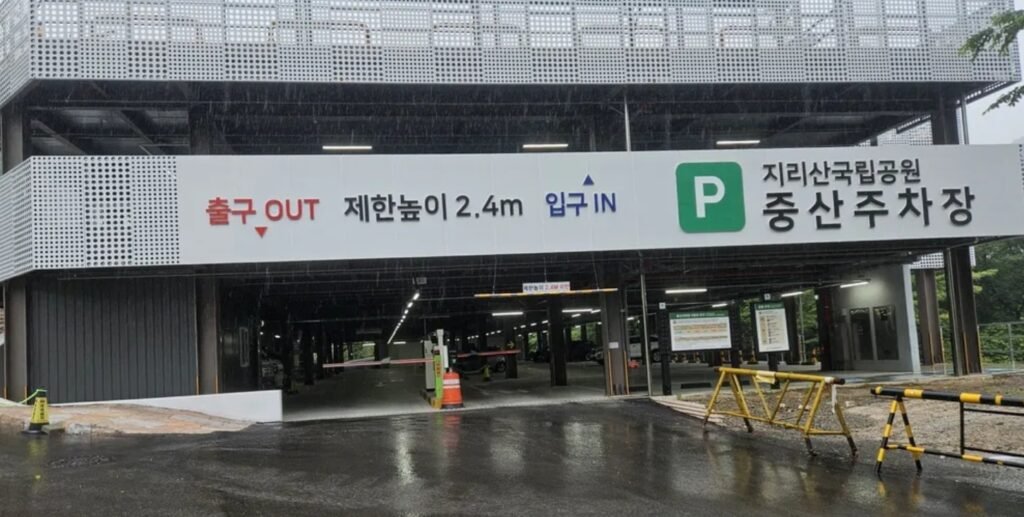
Photo Caption: The Jungsan-ri Sancheong Branch parking lot
III. Return Trip Info (Direct to Seoul & Alternatives)
Direct buses from Jungsan-ri to Seoul (Nambu Terminal) run only once a day (around 15:35), making it tricky to time.
A. Direct Bus: 15:35 (Check the schedule on the day). You must descend quickly to catch this.
B. Best Alternative: “Go via Jinju!”
- Jungsan-ri → Jinju: Buses to Jinju run every hour. (Last bus around 19:00–20:00 / Approx. 1 hour)
- Jinju → Seoul: Buses to Seoul run every 20–30 minutes until late. Enjoying a hot bowl of Gukbap (soup) near the terminal is the perfect way to finish!
- Train: Take the KTX from Jinju Station back to Seoul for a comfortable nap.
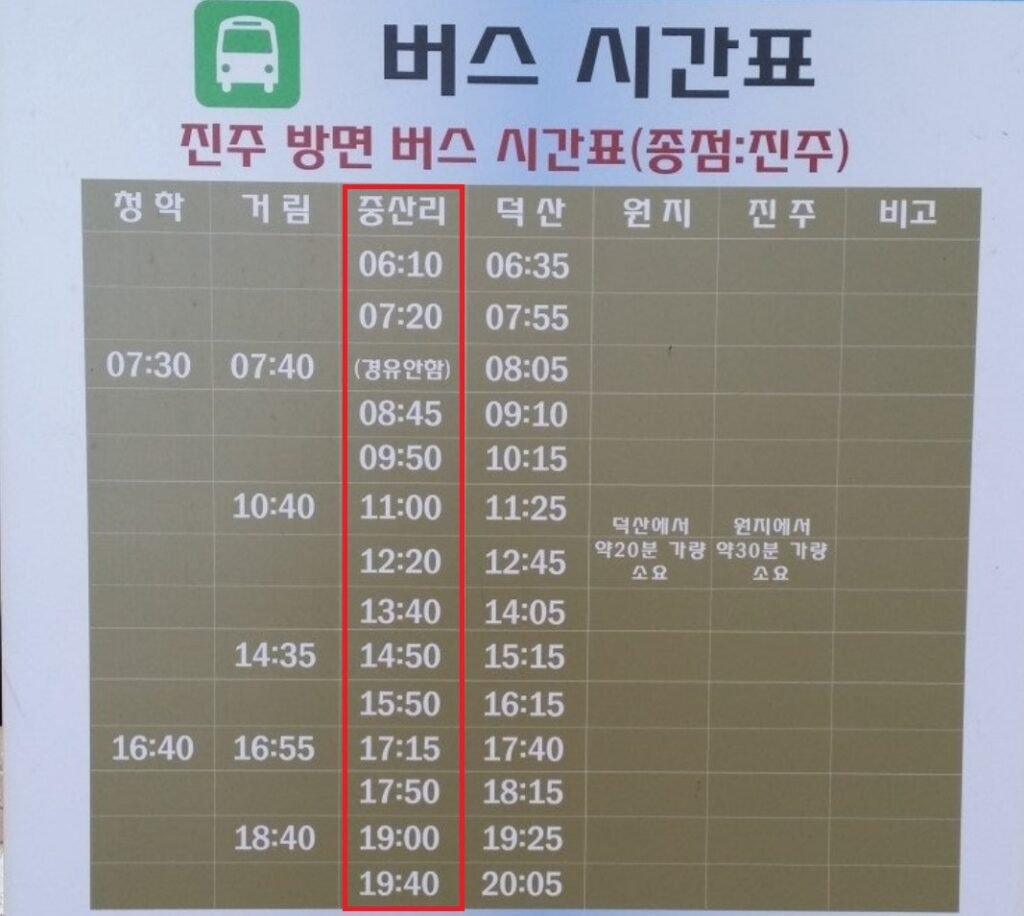
Photo Caption: Bus Schedule from Jungsan-ri to Jinju
IV. Jirisan Cheonwangbong Hiking Guide: Why Jungsan-ri is the Best?
In this Jirisan Cheonwangbong Hiking Guide, This is the shortest path (5.4km) to the summit. However, “shortest” means “steepest.” It is physically demanding, so pack plenty of snacks and water!
Jungsan-ri Course Overview
– Distance: 5.4 km (one way)
– Estimated Time: 4–5 hours to summit
– Difficulty: Hard (steep climb)
– Starting Point: Jungsan-ri Visitor Center
– Highest Point: Cheonwangbong (1,915m)
A. Jirisan Jungsan-ri 4-Step Summary
- Purple Line: The path / Red Circle: Start & Summit / Purple Circle: Rest stops
- Step 1: Start (Jungsan-ri Visitor Center) Tie your laces tight. Grab a map and use the restroom here.
- Step 2: The Cheat Key (Sunduryu Shuttle Bus) Take the shuttle toward the Environmental Education Center (5-10 mins). Get off at ‘Sunduryu.’ The real hike starts here.
- Step 3: The Oasis (Rotary Shelter) It takes about 2 to 2.5 hours from Sunduryu. Eat cup ramen at 1,450m altitude! You need this energy for the next steep section.
- Step 4: The Peak (Cheonwangbong Summit) Pass through Gaeseonmun Gate and climb for another 2 hours to reach the highest point.
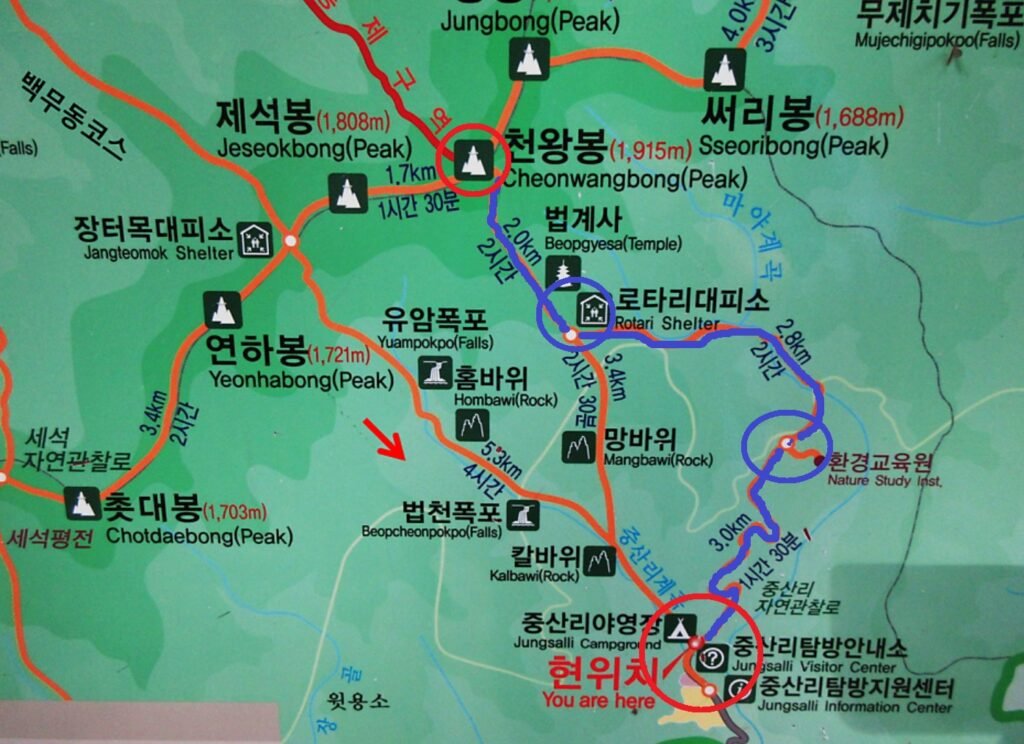
Photo Caption: Jungsan-ri Course Map
V. Pro-Tip: The ‘Sunduryu Shuttle Bus’ Guide
A. Quick Information
1. Route: Jungsan-ri Visitor Center ↔ Sunduryu
2. Duration: 5–10 minutes
3. Fare:
• Adult: 2,000 KRW
• Youth: 1,000 KRW
4. Payment: Cash or bank transfer only (No cards)
5. Free Eligibility:
• Seniors (70+)
• Preschool children
• Disabled visitors
• Veterans (ID required)
B. Why This Shuttle Matters
1. Strategic Advantage:
This is not just a convenience—it’s a smart strategy for reaching the summit efficiently.
2. Energy Conservation:
By skipping the 5.4km asphalt road, you can save crucial energy for the final steep climb.
C. Recommended For
1. Beginner hikers
2. Families with children
3. Hikers who want to focus on scenic trails rather than road walking
D. Key Benefits
1. Reduces hiking distance (5.4km → 4.8km)
2. Conserves energy for the most demanding section
3. Improves overall hiking efficiency
E. Important Tip
1. Arrival Timing:
Arrive 20–30 minutes early during peak seasons (spring and autumn).
2. Reason:
The shuttle can fill up quickly, and delays may affect your summit schedule.
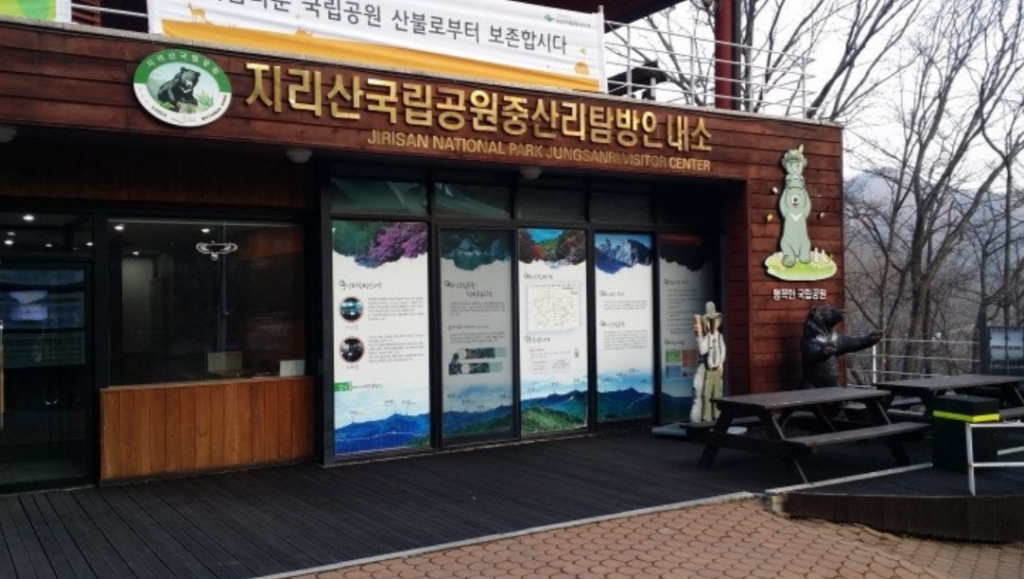
Photo Caption: jungsanri Visitor Center(Starting point)
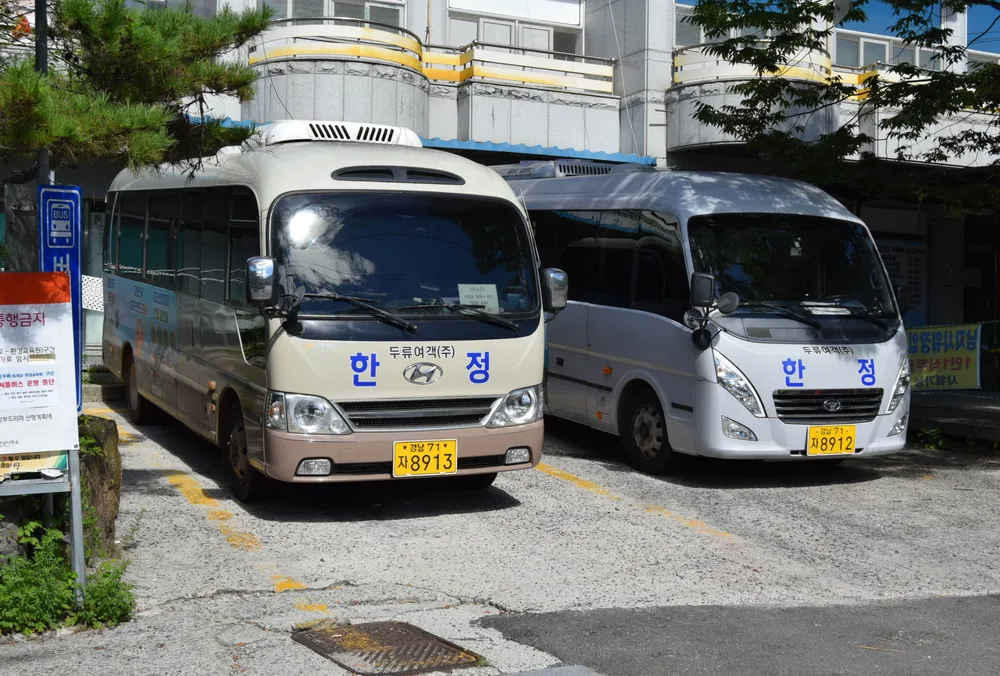
Photo Caption: Sunduryu Shuttle Bus
VI. A Taste of Heaven: Rotary Shelter
A. Best Menu: Half-cooked ramen and Gimbap are the best. Experience the Korean ‘Jeong’ (affection) culture where hikers greet each other. Try saying “Annyeong-haseyo” (Hello)!
B. Energy Recharge: The remaining 2km is a notorious steep climb. Warm up with ramen broth before the final spurt. (Take your trash back!)
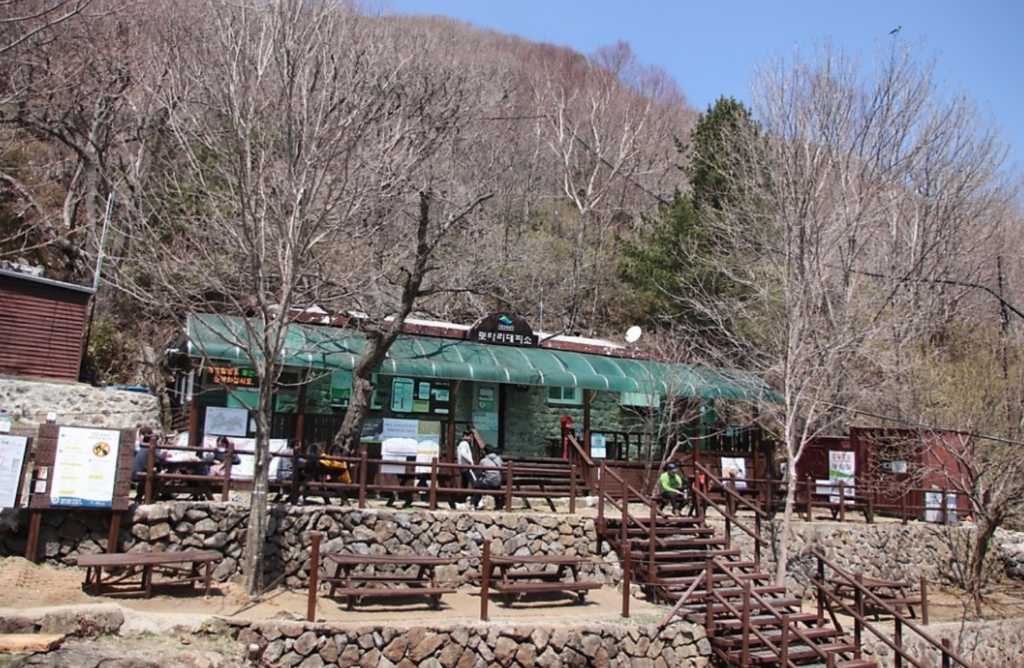
Photo Caption: Rotary Shelter
VII. Wonders of Jirisan: Sightseeing
A. Beopgyesa Temple: The second-highest temple in Korea at 1,450m. However, truth be told, most hikers are so exhausted that they often just pass it by. Actually, I was one of them! I just took a quick photo at the entrance gate and kept going.
B. Gaeseonmun Gate (Triumphal Arch): At 1,700m, two massive rocks stand like a gate.
- Meaning: “Gaeseonmun” means ‘Triumphal Arch.’ It means the summit is near.
- Mom’s Photo Spot: A cinematic location for your best shot.
- To Foreign Friends: It’s like the one in Paris, but made by nature!
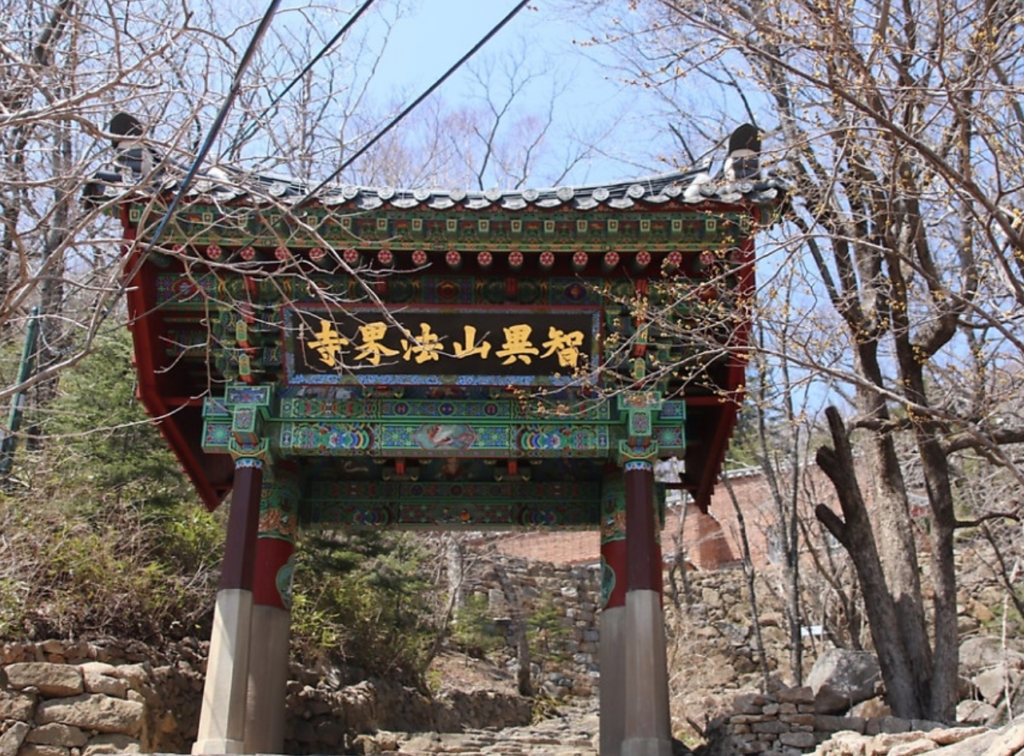
Photo Caption: Beopgyesa Temple Gate
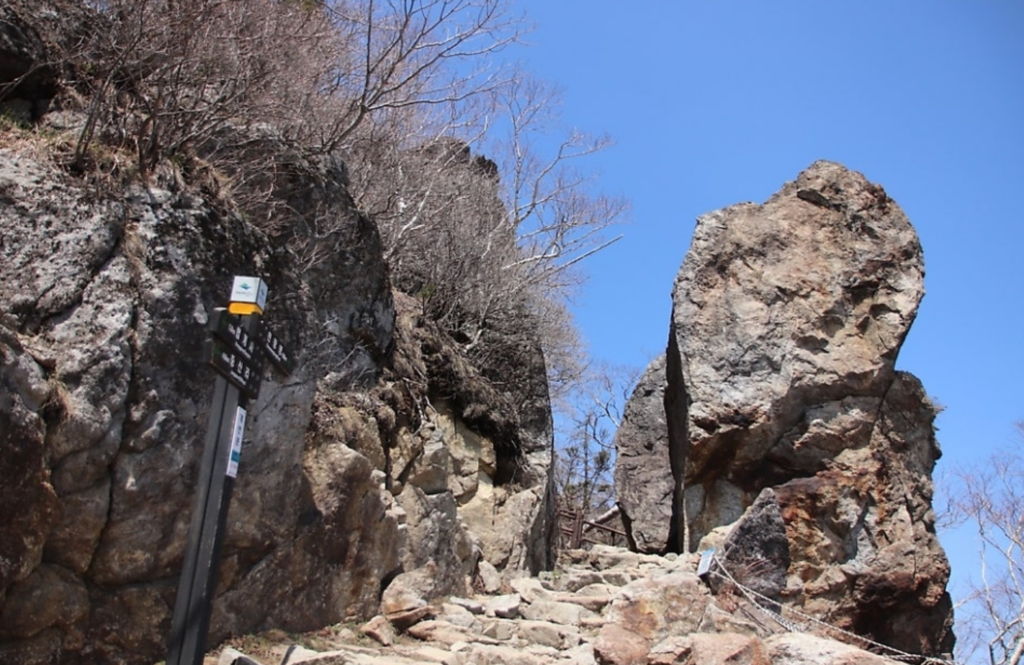
Photo Caption: Gaeseonmun Gate
VIII. An Unexpected Friend at the Safety Shelter
At the Small Safety Shelter built in 2026, I had a magical experience. A small bird, unafraid of people, flew down and ate snacks from my hand. It felt like a Jirisan fairy welcoming me. [Watch Video] A bird on my hand? A moment of connection.
Link: https://www.youtube.com/shorts/tYifXwuSw1Y
Mom’s Gentle Request: Please be careful when feeding wildlife for their health. Jirisan is full of mysteries!
IX. Standing at the Top: “The Spirit of Koreans Starts Here”
At the summit, the inscription on the back of the Cheonwangbong stone moved me: “The Spirit of Koreans Starts Here.” This is the very spot where the Korean spirit originates.
A. Life Shots: The panoramic view of mountain ridges and clouds is fantastic.
B. Safety First: The summit is steep and rocky. Be careful of strong winds and slippery rocks. Go slowly on the way down to protect your knees.
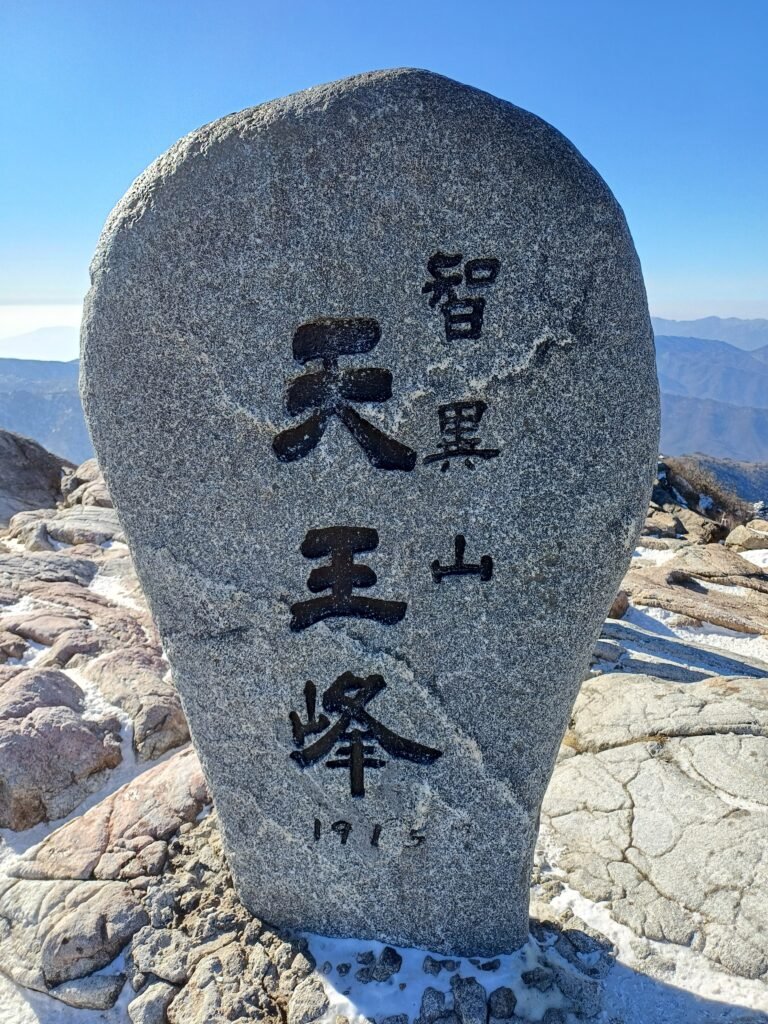
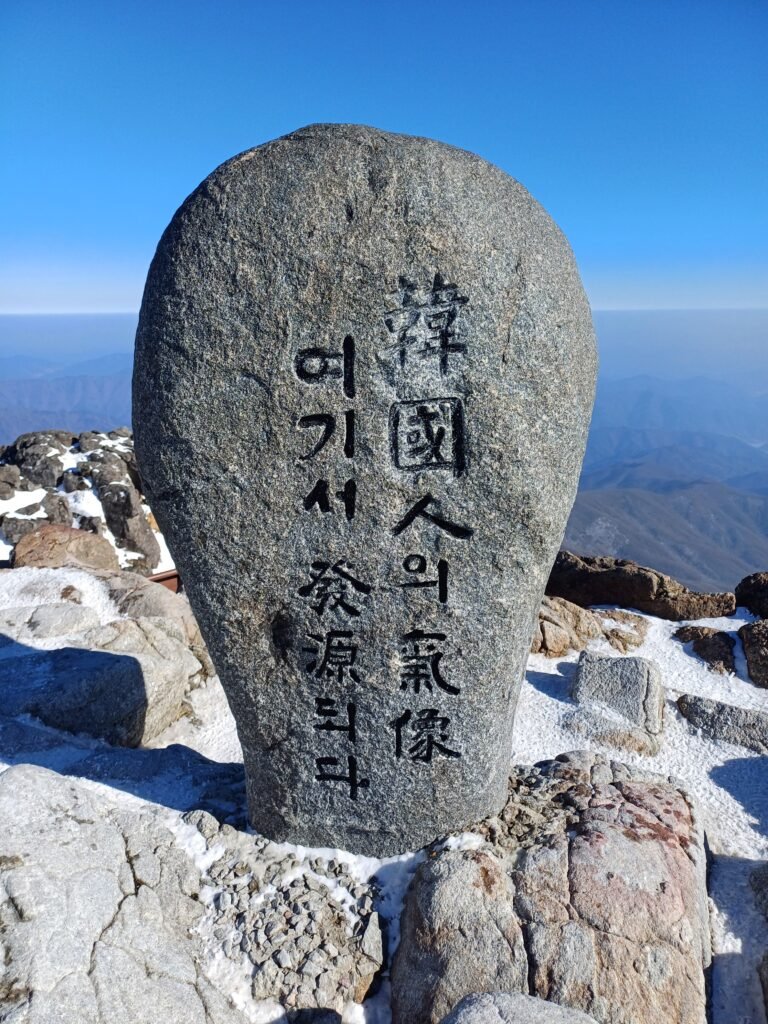
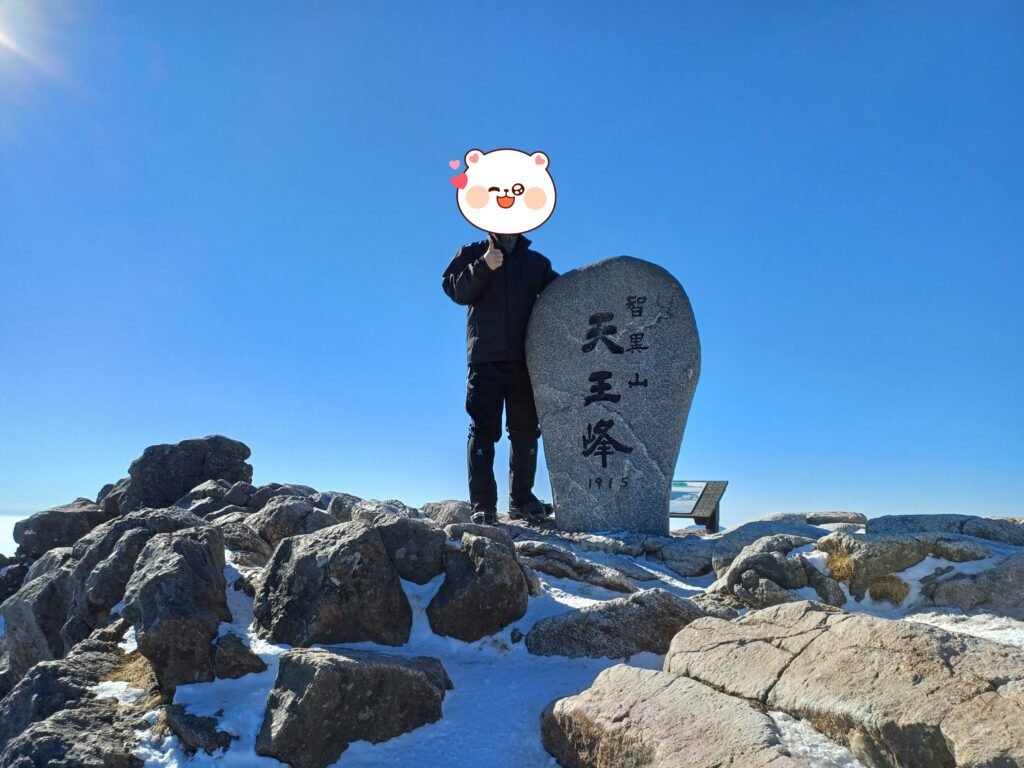
Photo Caption: Cheonwangbong stone
X. A Promise for Safety
A. Jirisan is home to Asiatic Black Bears, so stay on the trails.
B. In winter, you must have proper equipment such as crampons, gloves, and hiking poles for your safety.
C. Also, manage your stamina for the drive home.
No matter where you start, Jirisan Cheonwangbong awaits you. If a beginner mom like me did it, you can too! I hope our foreign friends create an unforgettable chapter of their lives here.
XI. FAQ
Q1. How long does it take to hike to Cheonwangbong?
A. It usually takes about 4–5 hours via the Jungsan-ri course.
Q2. Is the Jungsan-ri route suitable for beginners?
A. It is the shortest but also steep, so beginners should prepare well.
Q3. Do I really need to take the shuttle bus?
A. Not mandatory, but highly recommended to save energy.
Finished the “Roof of Korea”? Now meet the “Heart of Jeonju.” After experiencing the majestic spirit of Jirisan, why not embrace the serene beauty of my hometown?
👉 Deokjin Park Jeonju Travel Guide: Lotus Pond, Library & Hidden Local Spots
A perfect place to rest your soul and enjoy the real Jeonju vibe.
#Jirisan #Cheonwangbong #HikingInKorea #JirisanHike #KoreaTravel #HikingTips #Jungsanri